S3 buckets
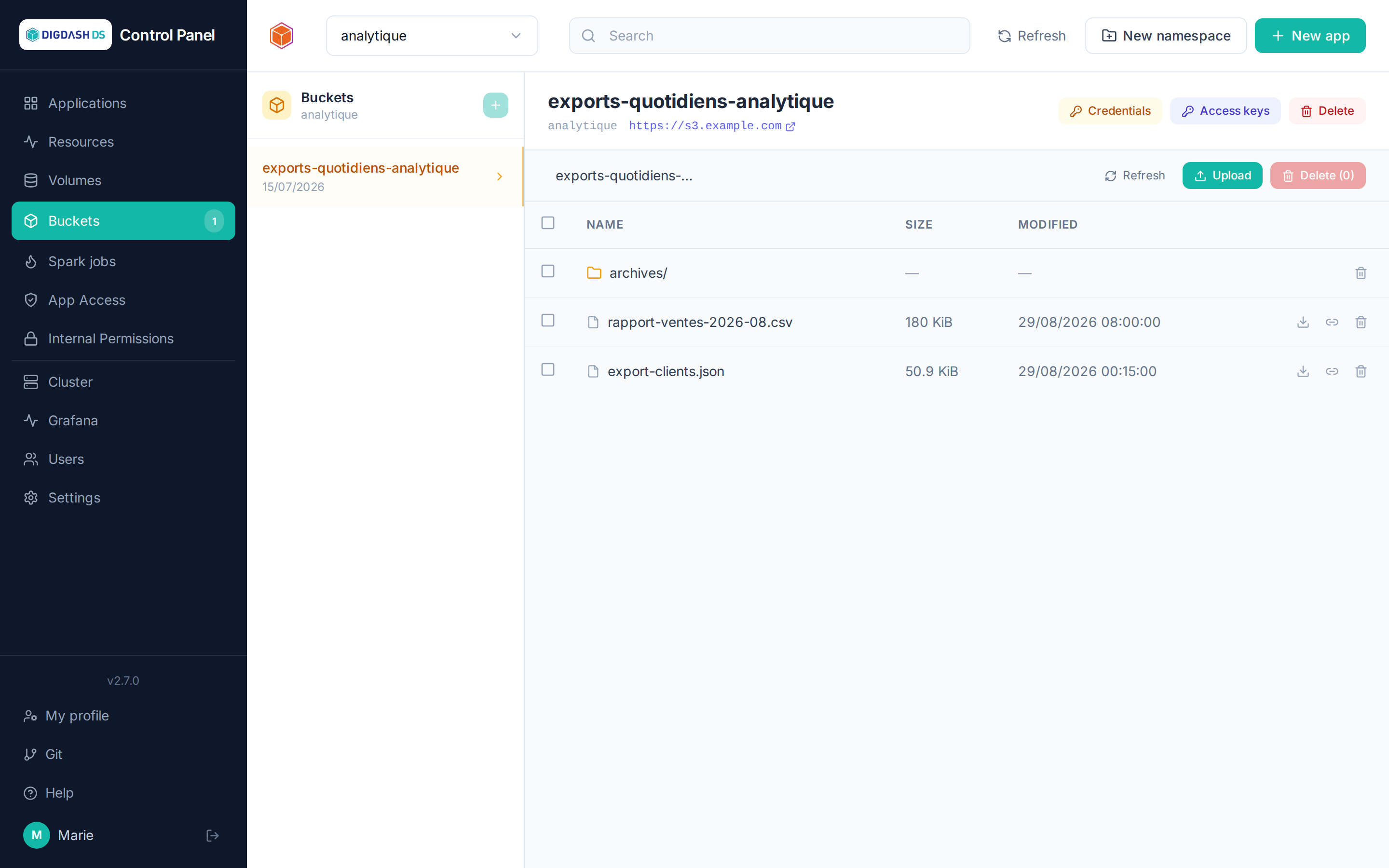
The Buckets page manages the namespace's S3 object storage (served by the cluster itself): file repositories, backup targets, data sources for Apache Hop…
Creating a bucket
New bucket → a short name (lowercase letters and digits). The bucket goes through a provisioning phase, then becomes Bound — it is then usable.
Access credentials
Each bucket exposes its S3 credentials (endpoint, access key, secret key) from its row in the list. These are the values expected by:
- the Backup section of PostgreSQL and Digdash BI;
- any external S3 client (rclone, AWS CLI, DBeaver…).
Per-application access keys
The Access keys tab lets you create additional, narrower-scoped S3 identities (read-only or read/write) to hand off to an application, rather than sharing the bucket's main credentials.
Browsing objects
A bucket's contents (files and folders) can be browsed directly from the page — useful for checking that a backup was actually written before starting a restore.